
How to Read Your Water Meter
• Detecting leaks • What to do if you detect a leak • What to do if your meter fails •
You can hire a licensed plumber to check for leaks, fix any problems, and recommend ways for you to conserver water. There are also some things you can do yourself! This page will help you be able to read your own water meter at any time, and give you ideas on how to find leaks in your system. We also tell you what to do if your meter fails.
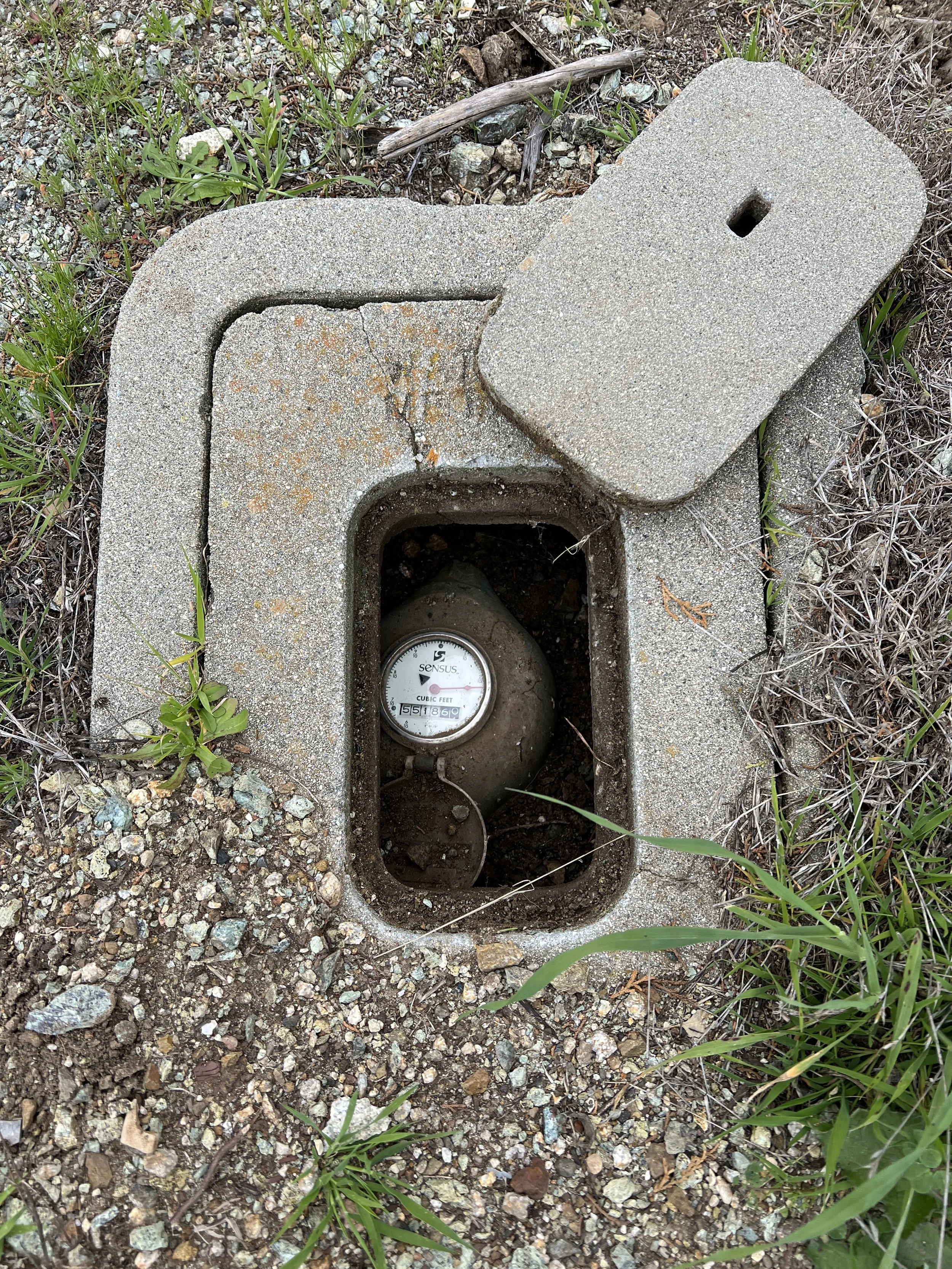
To read your meter, first you need to locate your meter. Most water meters can be found on your property near the street. Sometimes however, slumping hillsides, animals digging or bushes growing can make them hard to find. Here’s what a typical meter looks like:



The water company reads your water meter every month for conservation purposes. Every other month the reading is also used for billing purposes (January, March, May, July, September, and November). Meters are read as close to the first day of the month as reasonably possible.
Sometimes you may want to read your own water meter. You might want to check your water use, see if you have a leak, or verify the use shown on your water bill. With care, you can even use your water meter to determine how much water your irrigation system uses.
All of the customer meters in the Irish Hills Mutual Water Company are similar make and models: Sensus 1″ W-19 and Sensus 1″ SR II, which register water in cubic feet. For reference, there are 7.48 gallons in a cubic foot.
Your meter is under a two part concrete lid 1 to 3 feet off the edge of the street. Most meter box locations are marked on the curb with a blue painted W to make them easier to find.
Lifting the smaller concrete lid (as shown in the image above) reveals the meter itself. The meter has a bronze lid over the dial face which may be closed or already open.


There are 3 important parts to the meter dial. The most important is the register itself. That’s the part that looks like a mechanical car odometer. For our meters, the reel farthest to the right measures one cubic foot increments.
The red sweep hand measures one cubic foot per revolution (7.48 gallons). Each 1/10 (0.1) increment is 0.748 gallons. The individual tick marks register 1/100, or 0.0748 gallons.
In or near the center of the dial is a triangle (it may be black or white); this is the flow indicator. It will rotate when any water flow is being measured by the meter. If the triangle is not moving then either you are using no water or the meter is broken. If you know that you are using water and it the meter is not registering usage, please let us know immediately, We can help you purchase and install a replacement meter.
Using Your Water Meter to Detect Leaks
Your water meter can help you determine whether your water-using fixtures or irrigation system have leaks. The meter is the best place to begin your search.
Turn off all faucets and water-consuming appliances, including evaporative coolers and ice-makers in refrigerators
Make sure your sprinklers, drip or other irrigation systems are off
On your water meter, watch the flow indicator (white or black triangle). If it turns, however slowly, you have a leak or something is using water that you have not yet turned off
To get an idea of the size of the leak, note the meter reading and the needle’s position on the dial and note the time
Check the meter reading and the needle’s position again after 15-30 minutes. Each black mark around the edge of the dial is 0.01 cubic feet (0.0748 gallons)
How do you decide whether there is a leak somewhere inside the house, in your irrigation, or between the water meter and the house? Turn off your house valve and if the needle on the water meter’s dial (or the flow indicator triangle) continues to move, you may have a leak in your irrigation or in the water pipes between your property and the water meter. If the needle stops moving after you turn off your house valve, you may have a leak within your house. Consider contacting a plumber to check the problem.
Even if your meter did not show any signs of leaks in your home, it’s still a good idea to periodically check for leaks. Start with your toilets and faucets.
You can easily check your toilet tank for leaks by putting a few drops of food coloring in the tank. Wait a while and check the bowl. If there is colored water in the bowl, the flapper valve is probably leaking and should be replaced.
If you find a leak and it’s not something you can easily fix yourself, we recommend hiring a licensed plumber to solve the issue, check for other potential leaks, and recommend ways for you to conserve water.
What if I Need a New Meter?
Homeowners are responsible for their water meters and anything on the house side of the meter (conversely, anything on the street side is the responsibility of the Water Company). If your meter fails, you’ll want to have a professional plumber to install a replacement. When installing the replacement it’s a good idea for them to inspect the lines coming into and going out of the meter and install valves for easier maintenance, add on a backflow prevention device, or make any other improvements needed for reliable water service.
The Irish Hills Mutual Water Company has a small stock of water meters that we make available to customers at our cost. See the fee card for the latest pricing.